
Table of Contents
- Quick Comparison: 7 Best Cat Window Perches
- What Makes a Heavy Duty Cat Window Perch Worth Buying
- The 7 Best Cat Window Perches for Indoor Cats
- How to Install a Cat Window Perch on Any Window Type
- Cat Window Perch Safety Tips Every Owner Should Know
- Long-Term Suction Cup Maintenance and Glass Care
- Conclusion
- Frequently Asked Questions
Last Updated: September 22, 2026
Quick Comparison: 7 Best Cat Window Perches
The best cat window perches for indoor cats balance weight capacity, mounting security, and comfort. This guide from Trending Now Co. breaks down seven standout options by window type, cat size, and budget so you can pick the right one without guessing.
Indoor cats spend most of their lives within the same four walls, and vertical space is often the missing piece. A window perch turns dead glass into a heated observation deck with a front-row seat to birds, squirrels, and passing traffic.
Below, we'll show you how to match a perch to your window, your cat's weight, and your routine. The seven picks range from suction cup hammocks to screw-in platforms, plus foldable options for tight spaces.
| Perch Type | Best For | Mounting | Weight Capacity |
|---|---|---|---|
| Suction cup hammock | Smooth glass, renters | Suction cups | Light to medium cats |
| Sill-mounted platform | Wide window sills | Bracket on sill | Medium to heavy cats |
| Screw-in perch | Permanent setups | Screws into frame | Heavy cats |
| Foldable perch | Small apartments | Suction or bracket | Light to medium cats |
| Modular system | Multi-cat homes | Mixed hardware | Varies by module |
Most guides rank perches by popularity, not by whether the thing will actually hold your cat at 3 a.m. Weight capacity and mounting method matter more than any "best of" badge.
What Makes a Heavy Duty Cat Window Perch Worth Buying
A heavy duty cat window perch earns its price through three things: real weight capacity, industrial strength suction or reinforced brackets, and a frame that does not flex under load. Skip one and you get wobble, sag, or a fall.
Weight capacity is the first number to check. Suction cup ratings assume clean glass and a properly seated cup. If your cat is heavier, a screw-in or sill-mounted perch with reinforced brackets is safer.
Weight Capacity, Suction Power, and Frame Materials
Suction power depends on cup diameter, seal quality, and glass cleanliness. Larger lever-lock cups hold better than plain press-on cups. Powder-coated metal resists bending; thin plastic can crack where the cup meets the platform.
A stable design also means a wide base.
The 7 Best Cat Window Perches for Indoor Cats
The best cat window perches for indoor cats fall into three families: suction cup hammocks for smooth glass, sill-mounted or screw-in platforms for heavier cats, and foldable or modular designs for small spaces. Below are seven picks organized by those categories, with the mounting method, weight class, and window type each one fits.
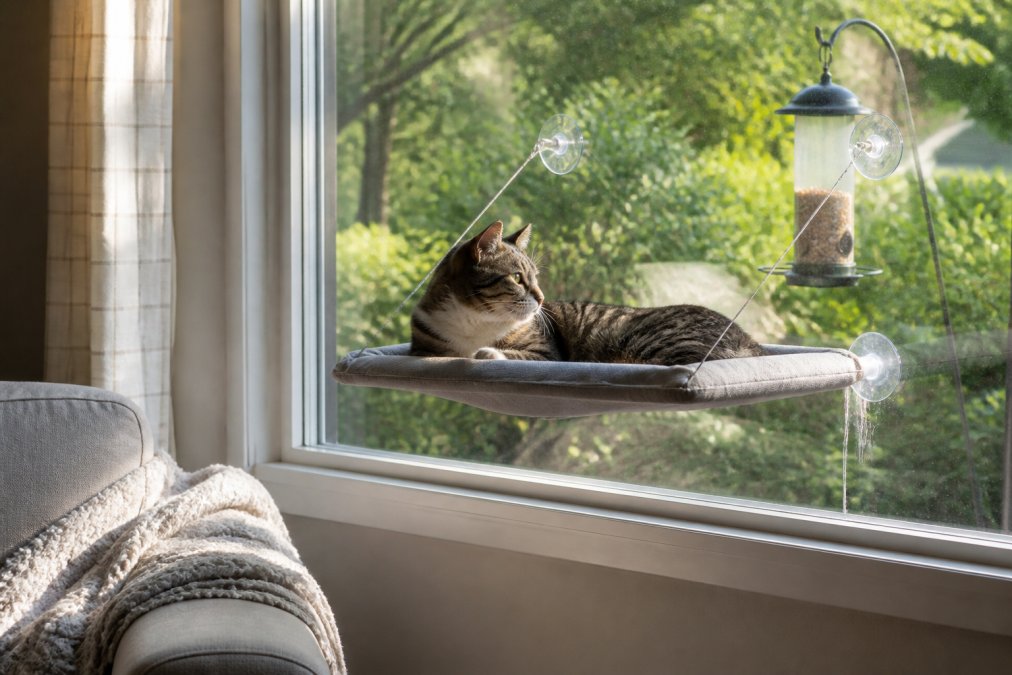
Suction Cup Hammocks for Smooth Glass
Suction cup hammocks are the easiest to install and friendliest for renters: they press onto clean glass, hold a washable cushion, and come off without a trace. The trade-off is smooth, non-textured glass and periodic re-seating.
Sill-Mounted and Screw-In Perches for Heavy Cats
Sill-mounted and screw-in perches are the answer for heavy cats. Instead of suction, they bolt to the window frame or rest a bracket on the sill, transferring the load into the window structure. Installation takes longer and may leave small holes, but the result is a wobble-free platform that holds up for years.
Space-Saving Foldable and Modular Options
Foldable perches flip up against the glass when not in use, keeping walkways clear in small apartments. Modular systems let you stack two or three platforms in one window, giving multi-cat homes separate spots without crowding one hammock.
How to Install a Cat Window Perch on Any Window Type
Most guides tell you to clean the glass and press the cups on. That advice breaks the moment you have a casement window, a slider, or a divided-light sash. Here is how mounting actually changes by window type.
Double-Hung and Single-Hung Windows
The easiest case. The lower sash gives you a large, flat pane of smooth glass, and the frame above it anchors a safety tether. Suction cup hammocks work here, and sill-mounted brackets work if the sill is at least 3 inches deep. Mount the perch on the lower sash at your cat's chest height, roughly 12-18 inches off the sill for an average adult cat.
Sliding Windows
Sliding windows have a vertical meeting rail where the panes overlap, interrupting the glass surface. A wide suction hammock may straddle it and lose its seal on one side. Mount a narrower perch entirely on one pane, or use a screw-in perch on the vinyl or wood frame beside the glass. Never mount a suction perch across the meeting rail, the seal will fail on the side over the gap.
Casement Windows
Casement windows crank open on a hinge, so the glass is only flat when fully closed. That rules out suction perches for any cat that likes an open window: the moment the sash swings out, the perch goes with it. Use a sill-mounted bracket perch on the interior sill, or a screw-in perch on the surrounding frame. If you want the window open, a floor-to-window cat tree beside the casement is safer.
Awning and Hopper Windows
These tilt open from the bottom or top and leave an angled pane. Suction cups need a flat, vertical surface, so they will not hold on the tilted sash. Mount on the fixed frame or sill instead, and keep the perch clear of the sash's swing path.
Divided-Light and Textured Glass
Any window with muntins (the grid bars dividing the glass) or with frosted, textured, or tinted-film glass will not hold a suction cup. The seal needs uninterrupted, smooth glass. On these windows, screw-in or sill-mounted perches are the only reliable option.
The Install Sequence That Works on Any of Them
- Identify your window type above and pick the matching mount before you buy.
- Clean the glass or frame with rubbing alcohol and let it dry fully.
- Mark the mounting height so the platform sits at your cat's chest level.
- For suction cups, press firmly and flip the lever to lock the seal.
- For screw-in mounts, pre-drill pilot holes and use the included hardware.
- Attach a safety tether from the perch to a window handle or frame anchor.
- Load-test with a weighted bag for 24 hours before your cat uses it.
Total Time: 20-40 minutes Difficulty: Beginner to intermediate
Cat Window Perch Safety Tips Every Owner Should Know
Cat window perch safety tips come down to four checks: weight rating, secure mounting, tether backup, and regular inspection. A perch that holds on day one can loosen by week six, so check it routinely.
- Confirm the perch is rated above your cat's current weight, not its kitten weight
- Re-seat suction cups every two weeks, or sooner in humid weather
- Use a safety tether as a backup on any suction-mounted perch
- Check screws and brackets monthly for loosening
- Keep the perch away from hot radiators and direct heat sources
- Watch for cracked glass or a warped frame and replace the perch if you see either
Long-Term Suction Cup Maintenance and Glass Care
Suction cups lose grip over time, dust, humidity, and temperature swings weaken the seal. The fix is a simple routine, not a new perch.
Conclusion
Choosing among the best cat window perches for indoor cats comes down to matching the mount to your window and your cat's weight. Get that right, and the perch becomes a daily favorite instead of a dust collector.
Frequently Asked Questions
What is the best cat window perch for large cats?
Large cats need a perch rated for at least 30 pounds, ideally with reinforced brackets or screw-in mounting rather than suction cups alone. Look for heavy duty cat window perch models with wide platforms and wobble-free frames. Suction cup designs can work for cats up to about 20 pounds if the cups are industrial strength and the glass is clean. Always check the listed weight capacity before buying and add a safety tether for extra security.
Are suction cup cat perches safe for windows?
Yes, when installed correctly. Suction cup perches spread weight across multiple cups, so they rarely crack glass under normal use. The bigger risk is sudden failure if the cups lose grip. Clean the glass with alcohol before mounting, press each cup firmly, and re-check suction weekly. Adding a safety tether that loops around the perch frame and attaches to a window latch or screw hook prevents falls if a cup pops loose.
Can cat window perches be installed on windows without a sill?
Many can. Suction cup and adhesive-mounted perches rely on flat glass, not the sill, so they work on casement, fixed, and sliding windows with no ledge at all. Sill-mounted and screw-in models need a sill at least 2 inches deep. Before ordering, measure your window's depth and check the assembly instructions for minimum glass surface area, since some perches need a specific square footage of flat glass to hold securely.
Do cat window perches damage glass or window frames?
Suction cup perches leave no permanent marks if you clean the glass afterward, though mineral buildup can occur if cups stay in place for months. Screw-in models put small holes in the frame or wall, so they are best for permanent setups. To protect your windows, remove suction cups every few weeks, wipe both the cup and glass with warm soapy water, and avoid mounting on tinted or filmed glass, which can lift at the edges under load.