
Table of Contents
- Personalized Gift Production Time 2026: What to Expect
- How Long Does It Take to Personalize a Gift? Timeline by Technique
- Custom Gift Shipping Deadlines: Holiday Cutoffs and Order Timing
- Expedited Personalization Services: The Rush Order Workflow
- Material-Specific Lead Times: Why Some Gifts Take Longer
- Tracking and Communication Expectations for Custom Orders
- Step-by-Step: How to Order Personalized Gifts in Advance
- Common Mistakes That Delay Personalized Gift Delivery
- Frequently Asked Questions
Last Updated: September 20, 2026
Personalized Gift Production Time 2026: What to Expect
Most personalized gifts take between 3 and 10 business days to produce before they ship. That window covers the time a maker needs to receive your order, set up the design, run the customization, and check the finished piece.
How Long Does It Take to Personalize a Gift? Timeline by Technique
The technique decides the timeline. A simple printed photo mug moves fast. A hand-stitched monogram on a leather bag does not. Here's how the main methods compare.
| Technique | Typical Production Time | Best For | Rush Possible? |
|---|---|---|---|
| Laser engraving | 2-5 business days | Wood, metal, glass | Often yes |
| Monogramming | 1-3 business days | Textiles, robes, towels | Sometimes |
| Embroidery | 3-7 business days | Apparel, blankets, bags | Rarely |
| Custom photo printing | 1-4 business days | Mugs, canvases, prints | Often yes |
Laser Engraving and Monogramming
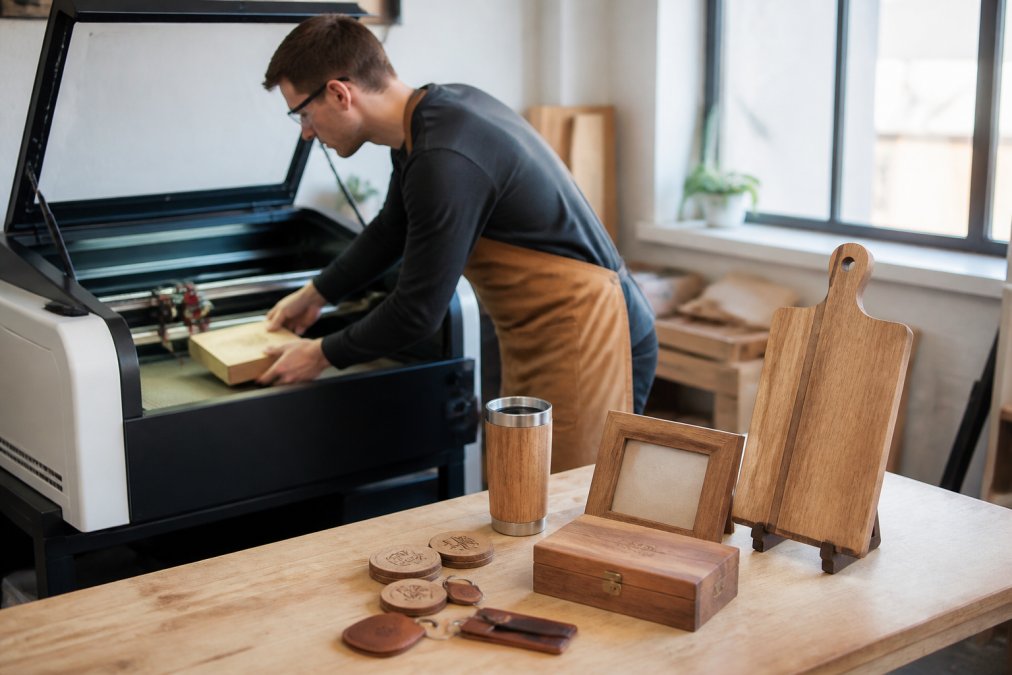
Laser engraving is one of the fastest custom methods. A shop loads your design, the machine burns it into the surface, and the item cools before packing. Most orders ship in 2-5 business days.
Embroidery and Custom Photo Printing
Embroidery takes longer because a person or machine stitches each item by hand or stitch by stitch. Expect 3-7 business days, more for large or complex designs.
Custom Gift Shipping Deadlines: Holiday Cutoffs and Order Timing
For major holidays, most makers publish a holiday cutoff calendar. Check it before you buy. The USPS holiday shipping deadlines give you the carrier side, but the maker's production window comes first.
Expedited Personalization Services: The Rush Order Workflow
Expedited personalization services skip the normal production queue for a fee. A rush order moves your item to the front of the line and often ships the same or next business day. But rush isn't a magic button, it works only when the technique, material, and shop capacity all allow it.
How Rush Fees Are Typically Structured
Most shops price rush as either a flat fee or a percentage of the order total. Common patterns:
- Flat fee per item, often $10-$25 for simple techniques like laser engraving or photo printing.
- Percentage surcharge, typically 20-50% of the item price, sometimes higher for same-day turnaround.
- Tiered rush, a smaller fee for "priority" (moves you up the queue) and a larger fee for "same-day" or "next-day" production.
The Rush Order Workflow, Step by Step
- Flag the order as urgent at checkout. If there's no rush option at checkout, contact the shop before ordering, don't assume they'll accommodate a request after the fact.
- Confirm the design within hours, not days. Rush orders live or die on fast proof approval. If you can't respond to a proof within a few hours, the rush is wasted.
- Production starts immediately, often the same day. The shop bumps your item ahead of standard orders in its queue.
- The item ships with expedited shipping. Rush production and expedited shipping are separate upgrades. Confirm both are included.
Which Techniques Can Actually Be Rushed
Rush works best when the technique has a short, predictable execution time and no curing or drying wait:
- Laser engraving, rush-friendly. Setup is the bottleneck, and a good shop can fixture and run a single item in under an hour.
- Custom photo printing, rush-friendly for flat items like prints and canvases. Mugs and ceramics are less so because of the curing step.
- Monogramming, sometimes rushable for simple initials on stock items.
- Embroidery, rarely rushable. Stitch files must be digitized, the machine runs one item at a time, and complex designs can take hours of machine time.
- Hand-finishing or bespoke builds, almost never rushable. The labor is the timeline.
Why Rush Orders Fail During Peak Season
Most shops cap the number of rush orders they accept per day. That cap exists because rush orders displace standard orders, and a shop that takes too many rush jobs misses its regular deadlines. During the holiday season, those rush slots fill first, often weeks before the standard cutoffs.
When Rush Isn't Worth It
If the item is fragile, hand-finished, or made-to-order, rush fees often can't compress the timeline meaningfully. In those cases, the better move is to choose a different gift or a different technique, a rushed simple item beats a missed complex one. For last-minute needs, consider a digital gift card or a non-personalized item paired with a handwritten note, which arrives on time without a production clock at all.
Material-Specific Lead Times: Why Some Gifts Take Longer
Lead time depends on the material as much as the method. This is the part most guides skip, and it's where the real delays hide.
How Material Properties Drive Production Time
Hard materials, wood, metal, glass, acrylic. These engrave quickly once the design is loaded because the laser or bit removes material predictably. The time cost is front-loaded into setup: fixturing the piece so it doesn't shift, and test-burning on scrap to dial in power and speed. Once that's done, a single pass often finishes in minutes. Metal may need a coating or masking step before engraving and a cleaning step after.
Why Bespoke Items Stack Timelines
If a maker builds the piece from scratch and then personalizes it, the two timelines add together, not overlap. A custom wooden box might take 5 business days to build and 2 to engrave, 7 total, not 5. Ask the maker whether the item is made-to-order or personalized from stock. Made-to-order almost always means a longer clock.
Material-Specific Lead Time Reference
| Material | Typical Added Time vs. Baseline | Why |
|---|---|---|
| Wood | Baseline | Predictable engraving, minimal finishing |
| Metal | +0-1 business day | Masking, cleaning, sometimes coating |
| Glass | +0-1 business day | Controlled cool-down, crack risk |
| Leather | +1-2 business days | Conditioning before and after |
| Fabric / canvas | +1-3 business days | Fray control, pressing, finishing |
| Ceramics / coated | +1-2 business days | Curing or sealing after print |
The Redo Factor
Some materials fail more often than others, and a redo resets the clock. Leather can crack or discolor. Glass can shatter. Thin wood can warp under heat. Reputable shops build a small buffer into their quoted lead times for exactly this reason. If a maker quotes an unusually fast turnaround on a fragile material, ask what happens if the first attempt fails, the answer tells you whether the buffer is real.
Tracking and Communication Expectations for Custom Orders
Custom orders need more communication than standard ones. You should expect a design proof, a production update, and a tracking number.
Here's what a good custom order flow looks like:
| Stage | What You Get | When |
|---|---|---|
| Order confirmation | Receipt and design details | Within hours |
| Digital proofing | A preview to approve | 1-2 business days |
| Production update | Notice that work started | 1-3 business days |
| Shipping notice | Tracking number | At dispatch |
Step-by-Step: How to Order Personalized Gifts in Advance
Ordering early removes almost all the stress. Follow these steps and you'll rarely miss a date.
- Pick the gift and technique. Match the method to the deadline.
- Check the production window. Find the maker's stated turnaround time.
- Add shipping days. Count business days, not calendar days.
- Order at least two weeks early. This covers proofing and surprises.
- Approve your proof fast. Slow approvals delay production.
- Track the order. Watch for the shipping notice.
- Follow up if silent. Ask for an update after two business days.
Common Mistakes That Delay Personalized Gift Delivery
- Skipping the proof. A wrong spelling ships as-is.
- Counting calendar days. Weekends and holidays don't count as business days.
- Choosing complex designs late. More detail means more production time.
- Ignoring holiday cutoffs. Peak season slows every step.
- Forgetting the buffer. Always pad your deadline by a few days.
We curate trending gifts across pet supplies, personal care, clothing, and home goods, with fast shipping to keep your timeline tight.
Frequently Asked Questions
How far in advance should I order personalized gifts for the holidays?
For holiday gifts, order at least 4 to 6 weeks before you need them. Production for made-to-order items like engraved jewelry or embroidered blankets often takes 5 to 10 business days, and shipping adds another 3 to 5 days. During peak season, from late November through mid-December, add a buffer of 1 to 2 weeks. Check the retailer's holiday cutoff dates and order early to avoid rush fees or missed deadlines.
Does engraving or embroidery add significant time to shipping?
Yes, personalization adds time because each item is made-to-order. Engraving typically adds 3 to 7 business days to the production cycle, while embroidery can add 5 to 10 business days depending on stitch complexity. These times are separate from shipping duration. Standard shipping adds another 3 to 7 business days. If you need it faster, look for expedited personalization services that compress the production window for an extra fee.
What factors influence the production time of custom gifts?
Several factors affect personalized gift production time in 2026: the customization technique (laser engraving is faster than hand embroidery), material (leather and metal may require extra curing or finishing), design complexity, and order volume. Digital proofing and quality assurance checks also add a day or two. During peak seasons, workshop capacity fills up, so lead times stretch. Always confirm the estimated turnaround time at checkout.
How can I track the status of my personalized order?
Most retailers provide order tracking once your item ships. You'll receive a confirmation email with a tracking number, and you can monitor progress from production to delivery. Some shops also send updates when your order enters the customization process and when it passes quality assurance. If you don't see movement after the stated production window, contact customer service with your order number for a status update.
Personalized gifts reward planning, not luck. The buyers who nail every deadline are the ones who order early and understand how production and shipping stack. Trending Now Co. makes that easier with a curated selection, a wide range of categories, and fast shipping, so you can find the right gift and get it there on time. Shop now with Trending Now Co. and check current turnaround times on every product page before you buy.