
Table of Contents
- Step 1: Match the Toy to Your Dog's Play Style and Size
- Step 2: Identify Eco-Friendly Dog Toy Materials
- Step 3: Verify Non-Toxic Dog Toys Before You Buy
- Step 4: Choose Durable Dog Toys for Aggressive Chewers
- Step 5: Consider Biodegradable Dog Toys and End-of-Life Disposal
- Step 6: Inspect, Clean, and Replace Toys Safely
- Conclusion: Building a Sustainable Toy Rotation
- Frequently Asked Questions
Last Updated: October 9, 2026
Step 1: Match the Toy to Your Dog's Play Style and Size
Choosing eco-friendly dog toys 2026 starts with your dog, not the label. A toy that fits how your dog actually plays gets used daily for months. A trendy one that ignores size or play style ends up shredded in a week.
Start by answering three questions:
- How does your dog play? Chewers, fetchers, tuggers, and problem-solvers need different designs.
- How big is your dog? A toy small enough to swallow is a choking hazard. Too large, and your dog loses interest.
- How old is your dog? Puppies mouth everything. Seniors need softer, easier-to-grip shapes.
Play style decides the category. Chewing intensity decides the material. Size decides the exact product.
Step 2: Identify Eco-Friendly Dog Toy Materials
Eco-friendly dog toy materials fall into two broad groups: natural fibers and recycled plastics. Each has real strengths and real limits, and each comes with labeling that ranges from precise to deliberately vague.
Natural materials include natural rubber, organic cotton, hemp, wool, bamboo, and coconut fiber. They come from plants or trees, and many break down over time.
Recycled materials include recycled plastic and reclaimed fabric. They keep waste out of landfills and often hold up longer than virgin plastic.
Here's how they compare in practice:
| Material | Best For | Durability | Breaks Down? |
|---|---|---|---|
| Natural rubber | Power chewers | High | Slowly |
| Organic cotton | Gentle players | Low | Yes |
| Hemp | Rope and tug toys | Medium-high | Yes |
| Wool | Fetch and comfort toys | Medium | Yes |
| Recycled plastic | Interactive and puzzle toys | High | No |
| Coconut fiber | Textured chew surfaces | Medium | Yes |
Natural Fibers vs. Recycled Plastics
Natural fibers win on end-of-life. They compost or degrade, and they skip petroleum-based production entirely.
Recycled plastics win on longevity. A recycled plastic puzzle toy may outlast three cotton plush toys, which matters if your dog destroys soft toys fast.
The honest answer: most households need both. Use natural fibers for comfort and tug play. Use recycled plastic for enrichment toys that take a beating.
How to Verify Material Claims Before You Buy
Most toy packaging uses broad terms, "natural," "eco-friendly," "green", that have no legal definition for pet products. That means the burden of verification falls on you. Here's a practical checklist for reading a label or product listing:
- Look for a specific material name. "Natural rubber" or "organic cotton" is verifiable. "Rubber blend" or "soft fabric" is not.
- Check for a certification. Third-party certifications like USDA Organic, Global Organic Textile Standard (GOTS), or OEKO-TEX Standard 100 indicate independent verification of fiber content or chemical safety. Not all toys carry them, but their presence is a positive signal.
- Look for recycled-content percentage. A toy labeled "made with recycled plastic" may contain as little as 5% recycled material. Look for a specific percentage (e.g., "made from 100% recycled PET") to gauge actual impact.
- Check dye and finish disclosures. Vegetable-based or mineral dyes are preferable to unspecified "assorted dyes." If the label doesn't say, assume synthetic.
- Inspect for coatings. Some rubber toys are coated with a glossy finish that may contain phthalates or other plasticizers. A matte, dry surface is generally a better sign than a shiny, slick one.
- Smell the toy. A strong chemical or plastic odor often indicates low-grade materials or residual solvents. A neutral or slightly rubbery smell is normal.
USDA Organic certification standards
Step 3: Verify Non-Toxic Dog Toys Before You Buy
Non-toxic dog toys carry no harmful dyes, no lead-based paints, and no phthalates in the rubber or plastic. The problem is that "non-toxic" is a marketing word, not a regulated one on most toy packaging.
That means the checking is on you. It takes about 60 seconds per toy.
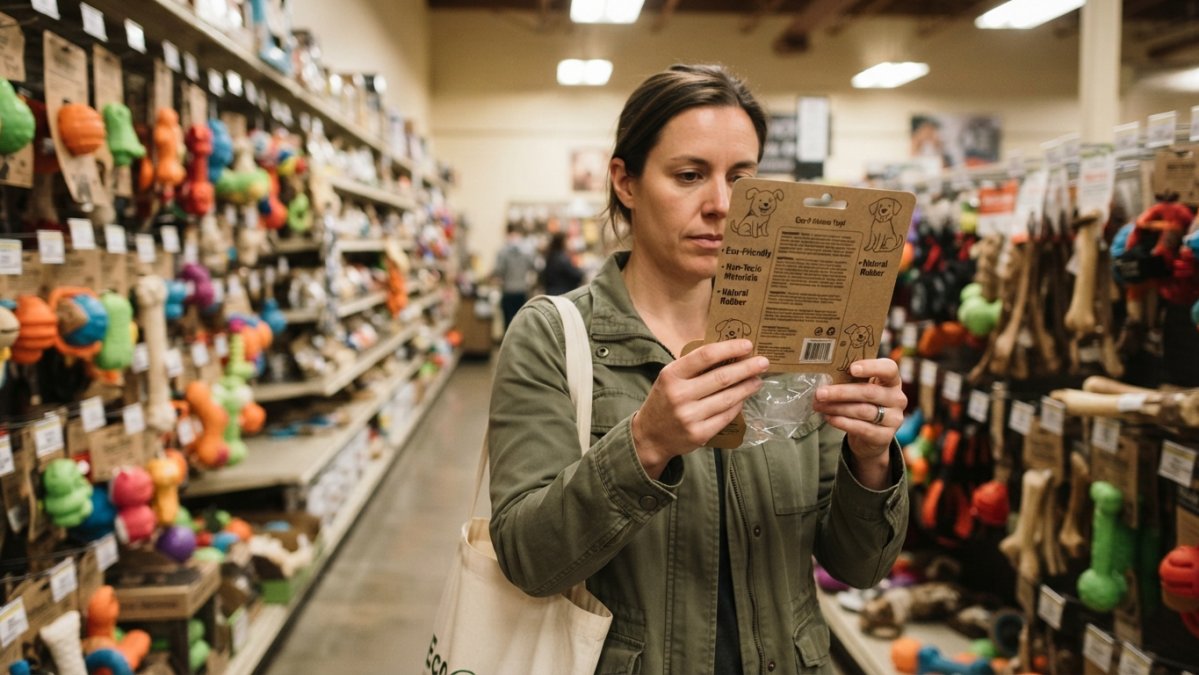
A Practical Material-Verification Checklist
Run every toy through this list before it goes in your cart:
- Material is named specifically. "Natural rubber" beats "rubber blend."
- No vague "fragrance" or "secret" ingredients listed.
- Color comes from vegetable or mineral dyes, not "assorted dyes."
- No strong chemical or plastic smell when you open the package.
- Stitching and seams are tight with no exposed glue.
- Squeaker is fully enclosed and cannot be pulled out.
- Washing instructions exist. If the maker won't say how to clean it, that's a red flag.
If a listing hides its materials, assume the worst and move on. Plenty of makers label clearly.
Step 4: Choose Durable Dog Toys for Aggressive Chewers
Durable dog toys for aggressive chewers need thick walls, solid construction, and no small parts.
Bite strength varies enormously by breed and individual dog. A toy rated "tough" for a terrier may last minutes with a large working breed.
What actually holds up:
- Solid natural rubber balls with no hollow core to collapse
- Thick-walled rubber chew toys with rounded edges
- Reinforced rope toys made from tight, dense hemp or cotton weave
- Food-stuffed rubber toys that redirect chewing into problem-solving
For dogs who destroy everything, skip the fabric aisle entirely. Rubber and dense rope are your friends.
Pet Dog Rubber Ball Toys For Dogs →
Our Pet Dog Rubber Ball Toy is built from durable, non-toxic rubber with a textured surface that massages gums and helps clean teeth.

For chewers who need mental work too, the Interactive Rubber Slow Feeder Dog Ball is made from food-grade, non-toxic rubber. You stuff treats inside, and your dog works for them.

Step 5: Consider Biodegradable Dog Toys and End-of-Life Disposal
Biodegradable dog toys break down through natural processes instead of sitting in a landfill for centuries. That's the whole point of buying them.
But "biodegradable" only helps if the toy actually reaches a compost or degradation environment. A compostable toy in a sealed trash bag behaves exactly like plastic. And many curbside recycling programs won't accept mixed-material pet toys at all.
What Actually Happens to Your Toy After It's Worn Out
The end-of-life path depends on material and local infrastructure:
- Natural rubber and hemp: These may be accepted at industrial composting facilities, but most curbside programs don't take them. Check your municipal waste website for a "compostable" or "organic waste" category.
- Organic cotton and wool: Often compostable at home if you remove squeakers, plastic eyes, and synthetic stitching. Home compost piles need the right carbon-to-nitrogen ratio, so add these in small amounts.
- Recycled plastic toys: Rigid plastic toys may be recyclable if your local program accepts #2 (HDPE) or #5 (PP) plastics. Soft, flexible plastics are rarely recyclable curbside. Remove batteries, squeakers, and any metal parts first.
- Mixed-material toys: These are almost always landfill-bound because separating the materials isn't economically feasible. Buy fewer, better-made mixed-material toys and use them until they're truly worn out.
A Practical Disposal Checklist
Before you toss any toy, run through this:
- Remove and dispose of batteries separately. Button batteries are hazardous waste and should go to a designated drop-off, not the trash.
- Remove squeakers and plastic parts. These are usually non-recyclable and can jam recycling equipment.
- Check for local textile recycling. Some municipalities and nonprofits accept clean fabric and rope for downcycling into industrial rags or insulation.
- Consider repurposing. A worn rope toy can become a tug toy for a gentler player, or a chew toy can be cut into smaller pieces for supervised play.
- When in doubt, landfill it. If a toy is contaminated with saliva, dirt, or mold, it's not recyclable or compostable. Putting it in the trash is the responsible choice.
The lifecycle picture matters more than the label. A hemp rope that lasts two years beats a compostable plush that dies in a week, even if the plush breaks down faster.
Step 6: Inspect, Clean, and Replace Toys Safely
Every toy needs a weekly inspection and a cleaning schedule that matches its material. This is the step almost everyone skips, and it's where safety breaks down.
Run this quick check every week:
- Tug and flex the toy. Cracks, splits, or stiff spots mean it's done.
- Check seams and stitching for pulled threads or exposed filling.
- Squeeze the squeaker area. If you feel a loose piece inside, toss it.
- Sniff the toy. A sour or chemical smell means bacteria or degrading material.
Cleaning depends on what the toy is made of:
| Material | Cleaning Method | Frequency |
|---|---|---|
| Natural rubber | Warm water and mild soap | Weekly |
| Rope and hemp | Machine wash, air dry | Every 2 weeks |
| Plush and wool | Hand wash, air dry | Weekly |
| Recycled plastic | Wipe down or rinse | Weekly |
Replace rubber toys at the first sign of cracking. Replace rope toys when strands fray into loose threads. Replace plush toys the moment stuffing appears.
Supervision is not optional with any toy. No toy is indestructible, and a determined dog can defeat almost anything.
For gentle players and puppies, the Interactive Bite-resistant Plush Octopus Pet Toy offers soft plush with sound features and a bite-resistant build. For small dogs and puppies who need solo entertainment, the Interactive Pet Rolling Ball Toy USB Rechargeable moves on its own and recharges by USB.

Conclusion: Building a Sustainable Toy Rotation
The real challenge isn't finding one perfect eco-friendly toy. It's building a small rotation that covers chewing, fetching, tugging, and problem-solving without filling a landfill.
Trending Now Co. curates trending pet supplies so you can find all of it in one place. Our selection includes durable non-toxic rubber toys, treat-dispensing enrichment balls, and plush options for gentler players. Fast shipping means your dog isn't waiting weeks for the next rotation.
Shop Now and build a toy box that's safer, longer-lasting, and easier on the planet.
Frequently Asked Questions
What should I look for in an eco-friendly dog toy?
Check the material label first. Look for natural rubber, organic cotton, hemp, wool, or recycled plastic. Avoid toys with strong chemical smells, which can indicate leftover solvents or dyes. The toy should match your dog's size and chewing intensity, and it should have no small parts that could break off. A toy made from recycled materials with a simple, readable ingredient list is usually a safer bet than one with vague marketing claims.
Are recycled-material dog toys safe for dogs?
Recycled-material dog toys are safe when the recycled content is food-grade or pet-safe and the toy has no loose fibers or sharp edges. Check that the toy is labeled non-toxic and free of BPA, phthalates, and heavy metals. Supervise your dog during the first few play sessions to see whether the material holds up. If you notice fraying, peeling, or a chemical odor, remove the toy and contact the seller.
Are eco-friendly dog toys durable enough for aggressive chewers?
Some are, but not all. Natural rubber and thick recycled plastic hold up better than thin plush or loosely woven rope. For aggressive chewers, choose a toy rated for power chewers and check it weekly for cracks or missing pieces. The Pet Dog Rubber Ball Toy from Trending Now Co. is made from durable, non-toxic rubber and suits dogs of all sizes, including those with chewing habits. Rotate toys so no single one takes constant abuse.
When should I replace a damaged dog toy?
Replace a toy as soon as you see cracks, holes, exposed stuffing, or loose pieces. For aggressive chewers, inspect toys every week. For moderate chewers, a monthly check is enough. Squeakers and small fragments are choking hazards, so remove them immediately. Even durable rubber toys wear down over time, and a toy that smells sour after washing should be replaced.