
Table of Contents
- Why Your 2026 Personal Care Haul Needs a Real Storage Plan
- Skincare Shelf Life and Storage: What Expires and What Survives
- Step-by-Step: Sorting Trending Personal Care Items by Category
- Decluttering Beauty Routines 2026: The 12-Step Routine Reset
- 2026 Beauty Storage Ideas for Small Spaces and Vanities
- Common Mistakes That Undo Your Organization System
- Conclusion: Build a Routine You Can Maintain
- Frequently Asked Questions
Last Updated: October 3, 2026
Why Your 2026 Personal Care Haul Needs a Real Storage Plan
Learning how to organize trending personal care items 2026 starts with one hard truth: your bathroom counter is not a shelf.
The result is wasted money. A serum that turns cloudy, an SPF that separates, a toothbrush sitting in a puddle of its own bacteria.
Below, we break down how to sort, store, and rotate your routine so nothing expires before you finish it.
Skincare Shelf Life and Storage: What Expires and What Survives
Skincare shelf life and storage come down to three forces: air, light, and heat. Control those and most formulas last far longer.
Here's the practical split:
- Water-based products (creams, lotions, cleansers): shortest life once opened, because water is where microbes grow
- Anhydrous products (oils, balms, vitamin C powders): longest life, no water to spoil
- Actives in airtight pumps: hold up better than jars you dip fingers into, since every dip introduces bacteria and oxygen
- SPF: degrades fastest in heat, so never store it in a car or sunny windowsill
A common mistake is keeping everything in the shower. Steam pushes moisture into open jars and breaks down preservatives faster than any other habit. A second common mistake is treating a $90 biotech serum like a $12 lotion, same shelf, same handling, same result: wasted money.
Reading Expiration Dates on Biotech and Regenerative Formulas
Most biotech skincare and regenerative formulas use two dates. The period after opening, shown as a small jar symbol with a number, tells you how many months the product stays stable once you open it.
Biotech and regenerative products often carry a shorter period-after-opening than conventional formulas, frequently three to six months rather than the twelve months a basic moisturizer might allow.
If a product has no date, write the open date on the label with a marker. That single habit prevents most waste.
Where to Store Serums, SPF, and Advanced Peptides
Advanced peptides and serums belong in a cool, dark drawer, not on a sunny shelf. Heat breaks peptide chains and makes formulas separate.
Store these in a closed cabinet or drawer:
- Vitamin C and other antioxidants
- Retinoids
- Advanced peptide serums
- Biotech ferments and probiotic formulas
Keep SPF in a drawer near the door so you actually use it. Light and heat are the two enemies here, and a drawer blocks both.
Temperature, Light, and Humidity: The Three Storage Levers for Biotech Formulas
For biotech, regenerative, and longevity-focused products, three levers matter more than any organizer you can buy:
- Temperature. A steady cool spot beats a fluctuating one. The bathroom counter next to a hot shower is the worst-case location; an interior closet shelf or a closed drawer away from appliances is the best. Refrigeration is not automatically better, most formulas are tested for room-temperature stability, and cold-then-warm cycling can cause separation. Only refrigerate if the label says to.
- Light. UV and even bright visible light accelerate oxidation in antioxidants, retinoids, and cultured ingredients. Opaque or amber glass and a closed drawer are your two best defenses. A clear bottle on a windowsill is the fastest way to ruin a premium serum.
- Humidity and air exposure. Every time you open a jar, you introduce moisture and oxygen. Pump bottles, airless dispensers, and single-dose ampoules exist precisely to limit that exposure, which is why so many 2026 biotech launches ship in them. If a product comes in an airless pump, don't decant it into a pretty jar, you'll undo the packaging's whole purpose.
A simple rule: the more a formula costs and the more "active" its claims, the more it deserves a cool, dark, closed home. Reserve the counter for the two or three products you use twice a day, and put everything fragile behind a door.
Step-by-Step: Sorting Trending Personal Care Items by Category
Sorting is where most people quit. The fix is to group by how you use the product, not by brand or bottle shape.
Follow these steps:
- Empty every drawer, shelf, and bag onto a towel.
- Group items into five piles: daily face, body, oral care, hair, and tools.
- Check every date. Toss anything past its window.
- Set aside backups in a separate bin, not mixed with daily items.
- Assign each pile a home and label it.
That last step matters more than it sounds. If a product has no fixed home, it drifts back to the counter within a week.
Oral Care and Hygiene Tools
Oral care tools collect moisture and bacteria, so they need airflow and separation. Don't let brushes touch each other or sit in standing water.
A UV toothbrush sanitizer solves both problems at once. The UV Toothbrush Sanitizer holds multiple brushes, includes a toothpaste holder, and uses UV light to cut bacteria on the bristles. It's compact enough for a shared bathroom or a travel bag.
Multi-Step Regimens and Product Backups
A 12-step routine needs a rotation rule, not more shelf space. Keep only what you use this week up front. Everything else goes into backup storage.
Try this:
- Daily items in the front row
- Weekly treatments in a labeled bin
- Unopened backups in a dark, cool box
- Anything opened more than six months ago gets checked first
This keeps a multi-step regimen from turning into clutter.
Decluttering Beauty Routines 2026: The 12-Step Routine Reset
Decluttering beauty routines 2026 means cutting what you don't use, not what you own. Most people keep 30% of their products out of guilt, not habit.
Run this reset once a season:
- Pull everything out and check dates
- Set aside anything unused in 60 days
- Toss products that changed color, smell, or texture
- Donate unopened, in-date items where allowed
The goal is a routine you can complete on a tired Tuesday. If a step only happens when you have extra time, it's a backup, not a staple.
2026 Beauty Storage Ideas for Small Spaces and Vanities
2026 beauty storage ideas work best when they use vertical space and magnets instead of counter area. A small vanity has more usable wall than surface.
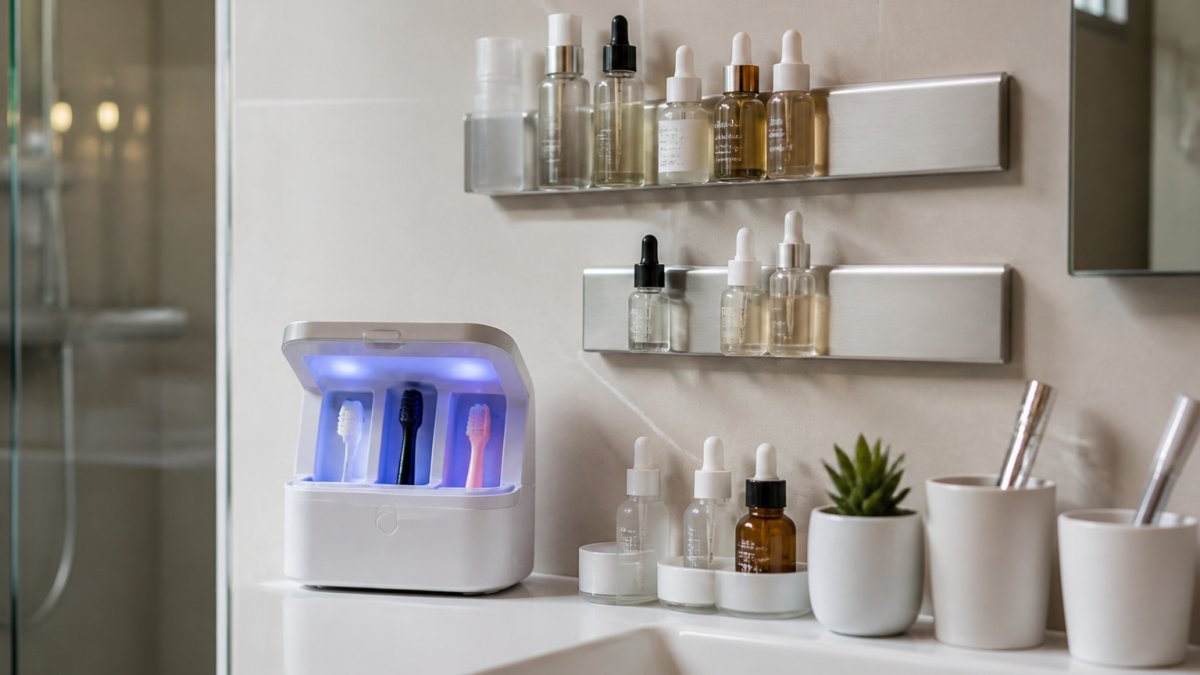
Start by clearing the counter completely. Then add storage upward.
The Minimalism-vs-12-Step Conflict, Solved
The honest math: a full 12-step routine can mean 12 to 15 physical products, plus backups, plus tools. No minimalist shelf holds that without looking cluttered. So split the routine into two zones:
- The visible zone (2-3 items). Whatever you use morning and night, cleanser, moisturizer, SPF, stays on the counter or in an open caddy. This is the "minimalist" face of your routine.
- The hidden zone (everything else). Serums, treatments, masks, and backups live in closed drawers, a cabinet, or a stacked tower. Out of sight, but sorted so you can pull the right step in seconds.
This is how you get a counter that photographs like a minimalist vanity while still supporting a complex routine. The trick is that the hidden zone must be organized, not just hidden, a drawer you have to dig through defeats the purpose.
Magnetic Surfaces, Vertical Storage, and Space-Saving Solutions
Magnetic surfaces and vertical storage free up the counter for the two things you use daily. Everything else can live on a wall or inside a drawer.
Try these space-saving solutions:
- Magnetic strips on the inside of a cabinet door for metal tools
- Stacked clear drawers to see everything at a glance
- A riser shelf to double your cabinet height
- A wall-mounted rack for hair tools
- A small caddy that moves from shelf to shower
Clear containers beat opaque ones here. If you can't see it, you forget it exists, and it expires in the dark. For the hidden zone in particular, label each drawer or bin by routine step ("actives," "masks," "backups") rather than by brand, you'll find things faster and notice when a category is overstocked.
Small-Space Rotation for Multi-Step Routines
Space isn't the only constraint, time is. A 12-step routine stored badly becomes a 12-step routine you skip. Use a rotation system that matches your actual habits:
- Daily tier: the 3-4 steps you never skip, stored front and center
- Weekly tier: masks, exfoliants, and treatments, stored in one labeled bin you pull out on a set day
- Occasional tier: tools, devices, and seasonal items, stored up high or in a closet
If a product has lived in the occasional tier for two seasons without being touched, it's a candidate for the declutter pile, not a reason to buy more storage.
Common Mistakes That Undo Your Organization System
The most common mistake is buying storage before sorting. You end up with beautiful bins full of expired product.
Watch for these:
- Keeping everything in the shower. Steam ruins formulas fast.
- Mixing backups with daily items. You lose track of what's open.
- Ignoring open dates. Unmarked jars become mystery items.
- Buying organizers that hide products. Out of sight means out of rotation.
- Skipping the seasonal reset. Systems drift without a check-in.
Fix the sort first. Storage comes second, and it should match what's left.
Conclusion: Build a Routine You Can Maintain
A storage plan only works if it survives a busy week. Keep the daily items visible, date everything you open, and reset once a season.
Trending Now Co. makes that easier by curating the trending personal care items worth keeping in rotation. Our platform pulls the latest finds across personal care, pet supplies, clothing, and household goods into one place, with fast shipping and a curated selection.
Frequently Asked Questions
How do I store skincare products to maintain their effectiveness?
Keep most skincare away from direct sunlight, heat, and humidity. A closed cabinet or drawer works better than an open shower shelf for serums, advanced peptides, and regenerative formulas. Refrigerate products if the label recommends it, especially biotech skincare with live cultures. Store SPF below 77°F (25°C) because heat breaks down UV filters faster. Check expiration dates monthly and rotate older items to the front so you use them before they degrade.
What are the biggest organizing trends for personal care items in 2026?
Vertical storage and magnetic surfaces are leading the way, letting you use wall space instead of crowded countertops. Clear acrylic and glass containers keep products visible so nothing gets forgotten. Sustainable materials like bamboo and recycled plastic are replacing single-use organizers. Small-space solutions designed for 12-step routines are also gaining traction as multi-step regimens become standard.
How can I declutter my bathroom vanity effectively?
Start by emptying everything onto a towel. Group items by category: skincare, oral care, hair, and body. Check each product for expiration dates and toss anything past its shelf life or that smells off. Keep only what you use weekly within arm's reach. Move backups and seasonal items to a labeled bin under the sink or in a closet. A UV toothbrush sanitizer like the Fresh Beam model ($40.89) consolidates oral care tools into one compact device, cutting countertop clutter.
How often should I replace personal care products?
Mascara lasts about 3 months after opening. Liquid foundation and concealer last 6 to 12 months. Serums with advanced peptides or biotech skincare typically last 6 to 12 months unopened but degrade faster once opened. Sunscreen expires after 3 years unopened or sooner if stored in heat. Toothbrushes should be replaced every 3 to 4 months, though a UV toothbrush sanitizer can reduce bacteria between changes. Label open dates with a marker to stay on track.