
Table of Contents
- Why Bored Cats Need Interactive Play
- How to Entertain a Bored Cat: A Daily Play Framework
- Interactive Cat Toys for Bored Cats Reviews: Top Picks Compared
- Safe Cat Toys for Unsupervised Play: What to Check Before You Leave
- Best Puzzle Feeders for Cats: Adding Food to the Hunt
- Troubleshooting: When Your Cat Ignores Every Toy
- Frequently Asked Questions
Last Updated: September 29, 2026
Why Bored Cats Need Interactive Play
An indoor cat with nothing to chase gets stressed, sedentary, and prone to behaviors owners misread as "acting out." This guide from Trending Now Co. covers the interactive cat toys for bored cats reviews that hold attention, plus the play framework that makes any toy work harder.
Signs Your Cat Is Bored and Inactive
Watch for the quiet signals first:
- Sleeping far more than usual, especially through active hours
- Staring at walls or fixating on one window
- Overgrooming, particularly bald patches on the belly or inner legs
- Pacing, meowing at night, or knocking objects off surfaces
- Losing interest in toys that used to trigger a pounce
A cat that ignores everything isn't lazy. It's under-stimulated.
The Science of Simulated Hunting and Prey Drive
Cats have a prey drive wired for a sequence: stalk, chase, pounce, catch, and eat. Toys that skip straight to "catch" feel incomplete, which is why a self-rolling ball or flapping bird outperforms a static stuffed mouse, erratic movement mimics prey and triggers the stalk-and-chase instinct.
How to Entertain a Bored Cat: A Daily Play Framework
The most effective way to entertain a bored cat is two structured play sessions per day, roughly 10 to 15 minutes each, timed around meals to mimic the hunt-eat-groom-sleep cycle:

- Morning: 10 minutes of active chase play before breakfast
- Midday: one puzzle feeder or self-play toy left out
- Evening: 15 minutes of high-intensity play before dinner
- Wind-down: a small treat or the last of the meal to close the "hunt"
The 3-3-3 Toy Rotation System
Toy rotation is the single most underused trick in feline enrichment. Cats habituate fast. A toy that's exciting on Monday is furniture by Friday.
The 3-3-3 system is simple:
| Phase | What to Do | Why It Works |
|---|---|---|
| 3 toys out | Keep three toys accessible at once | Enough variety without overwhelm |
| 3 days | Rotate the set every three days | Resets novelty and prey drive |
| 3 weeks | Retire favorites for three weeks before returning | Makes old toys feel new again |
Interactive Cat Toys for Bored Cats Reviews: Top Picks Compared
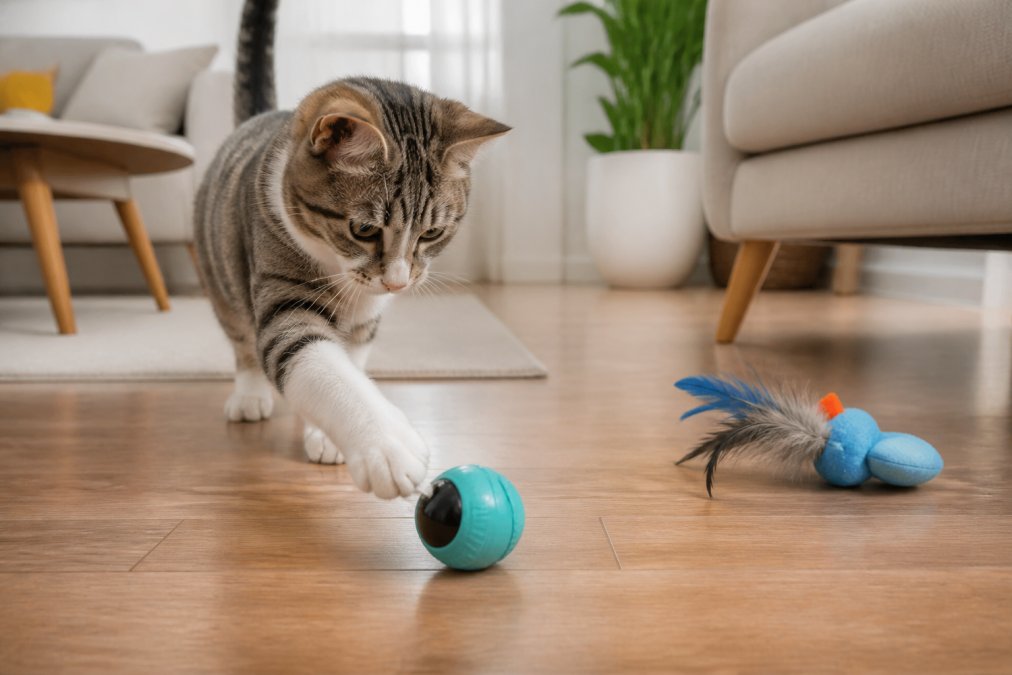
Every pick below comes from the Trending Now Co. pet range, and all five are under $17, rotation only works if you own enough toys to rotate. Each review adds two things most roundups skip: the behavioral mechanism the toy triggers, and a noise rating for skittish cats.
| Toy | Price | Power | Noise Level | Best For |
|---|---|---|---|---|
| PurrPlay Self-Rolling Cat Toy Ball | $6.66 | Motion-based | Silent | Solo play, skittish cats |
| Flapping Bird Cat Toy | $16.44 | USB rechargeable | Quiet motor | High-drive hunters |
| Smart Rolling Pet Ball | $3.27 | Battery included | Low hum | Budget rotation filler |
| Plush Bird Pet Toy | $10.35 | Battery-powered | Quiet motor | Gentle, older cats |
| Bite-resistant Plush Octopus | $5.61 | Sound-activated | Audible chip | Chewers and wrestlers |
1. PurrPlay Self-Rolling Cat Toy Ball ($6.66)
Best for: solo play and cats that prefer to hunt alone.

PurrPlay Self-Rolling Cat Toy Ball
2. Flapping Bird Cat Toy ($16.44)
Best for: cats with a strong airborne prey drive.
The priciest pick, and worth it for the right cat. Lifelike flapping wings mimic a bird in distress, and it's USB rechargeable with a motor quiet enough for most anxious cats.
Flapping Bird Cat Toy
3. Smart Rolling Pet Ball ($3.27)
Best for: filling out a rotation on a tight budget.
Smart Rolling Pet Ball
4. Plush Bird Pet Toy ($10.35)
Best for: older cats and gentle players.
This one comes in sparrow, duck, and swallow shapes with battery-powered motion. The plush body suits senior cats or cats that like to carry their "catch" rather than shred it.
PurrPlay Self-Rolling Cat Toy Ball →
Plush Bird Pet Toy
5. Interactive Bite-resistant Plush Octopus Pet Toy ($5.61)
Best for: cats that wrestle and bite.
The octopus measures 32cm long and 8cm wide, comes in Purple, Green, Blue, or Orange, and pairs a bite-resistant plush body with built-in sound features. It's the pick for the cat that grabs toys and kicks.
Interactive Bite-resistant Plush Octopus Pet Toy
Safe Cat Toys for Unsupervised Play: What to Check Before You Leave
Safe cat toys for unsupervised play share three traits: no loose strings, no small detachable parts, and an automatic shut-off or motion-based design that won't run for hours. Safety also depends on whether the toy matches your cat's play style when you're not there to intervene.
Run this checklist before leaving any toy out:
- No ribbon, elastic, or thread longer than a few inches
- No parts smaller than your cat's mouth that could come loose
- Battery compartment screwed or sealed shut
- No exposed wiring on rechargeable toys
- Toy shuts off or stops when untouched
- Toy is sized for your cat's mouth, not so small it can be swallowed, not so large it frustrates
- No sound chip if your cat has shown anxiety around sudden noises
Why Unsupervised Play Fails More Often Than It Injures
Most owners worry about injury, but the more common failure is disengagement. A toy left out for hours stops being prey and becomes furniture, cats habituate to anything that doesn't change.
Noise Sensitivity and Anxiety: When Automatic Toys Backfire
Some cats don't want a louder toy, they want a quieter one. A motor hum or sound chip can push an anxious cat into avoidance, and you'll read it as "she hates toys" when she actually hates the noise. The fix is a noise audit: turn the toy on across the room and watch your cat's ears and tail; ears flat or tail tucked means the toy is too loud, not too boring.
- Baseline: Note your cat's normal ear and tail position while resting.
- Distance test: Activate the toy 10 feet away. Watch for ear flattening, tail tucking, or leaving the room.
- Approach test: Move the toy closer while it's running. A confident cat leans in; an anxious cat backs away.
- Repeat test: Try again the next day. One bad reaction could be a bad mood; two is a pattern.
Age-Specific Safety Notes
Safety rules shift with age, and most roundups ignore this.
- Kittens: Everything goes in the mouth. Avoid detachable parts and supervise all play until you know your kitten's chewing habits.
- Adults: Main risks are string-based toys and hard plastic that can crack into sharp edges. Inspect weekly.
- Seniors: Reduced vision and hearing mean a senior may not notice a toy until it's right next to them. Avoid fast-moving toys that startle, and check for arthritis-friendly ground-level motion.
Best Puzzle Feeders for Cats: Adding Food to the Hunt
The best puzzle feeders for cats turn mealtime into a hunt. Instead of a bowl that's empty in ninety seconds, a feeder makes your cat work for each bite, stretching a two-minute meal into ten minutes of mental stimulation, and completing the prey sequence of stalk, bat, and finally eat.
A few rules for getting started:
- Start easy. A feeder that's too hard teaches frustration, not fun.
- Use part of the regular meal, not extra treats, to avoid weight gain.
- Rotate feeders the same way you rotate toys.
- Supervise the first few sessions, then reassess.
Troubleshooting: When Your Cat Ignores Every Toy
| Problem | Likely Cause | Fix |
|---|---|---|
| Walks away mid-play | Toy moves too predictably | Switch to erratic, self-rolling motion |
| Only plays for 30 seconds | Session too long or too early | Shorten to 5 minutes, move it before meals |
| Watches but won't pounce | Toy too far away | Drag it close, then let it "escape" |
| Ignores new toys instantly | Habituation | Rotate the set every three days |
| Hides when toy turns on | Noise sensitivity | Use motion-only toys, no sound chips |
Age changes everything. Kittens need short, frequent bursts and lighter toys. Adults want a real chase. Seniors often prefer slow, ground-level movement and soft plush they can carry.
Frequently Asked Questions
What are the best interactive toys for bored cats?
The best interactive cat toys match your cat's prey drive and energy level. Self-rolling balls like the PurrPlay ($6.66) work well for cats that chase, while the Flapping Bird Cat Toy ($16.44) suits cats that pounce on airborne targets. For food-motivated cats, puzzle feeders add a hunting challenge. Buy two or three types and rotate them weekly so novelty stays high and boredom does not return.
How can I keep my bored cat entertained when I am at work?
Set up self-play toys before you leave. Motion-activated balls with automatic shut-off run in bursts, then rest, which mimics real hunting cycles. Pair one with a puzzle feeder so your cat works for part of its meal. A window perch adds visual stimulus. Rotate which toys are out each day so the same two items do not sit on the floor all week.
Are automatic interactive toys safe for cats to use alone?
Most are safe if you check a few things first. Look for non-toxic, cat-safe plastics or silicone, no loose strings or small detachable parts, and automatic shut-off so the motor does not overheat. Skip toys with exposed batteries. If your cat is noise-sensitive, test the toy while you are home before leaving it out, since a loud motor can cause anxiety rather than play.
How often should I rotate my cat's toys to prevent boredom?
A weekly rotation works for most cats. Keep three toys out, store the rest, and swap the set every seven days. This keeps each toy feeling new without buying more. If your cat loses interest within a day or two, shorten the cycle to every three or four days. Pair rotation with short daily play sessions using a wand toy for the strongest effect.
How can I tell if my cat is bored?
Common signs include excessive sleeping, overgrooming, pacing, meowing at night, and destructive behavior like knocking items off shelves. A bored cat may also sit staring at walls or follow you constantly. If your cat shows these patterns and has few outlets for predatory instincts, adding interactive play and puzzle feeders usually reduces them within a week or two.