
Table of Contents
- The real cost of sustainable fashion
- Sustainable clothing vs. fast fashion: what the price gap actually pays for
- Cost per wear clothing: the math that settles the debate
- Affordable sustainable clothing: how to build a wardrobe without the premium
- How to identify sustainable fashion brands (and catch greenwashing)
- Materials and durability: which sustainable fabrics earn their price
- Conclusion: when sustainable fashion is worth it for you
- Frequently Asked Questions
Last Updated: October 7, 2026
The real cost of sustainable fashion
Is sustainable fashion worth the price in 2026? For many shoppers, it comes down to one number: how many times you actually wear the garment.
At Trending Now Co., we see this constantly: shoppers hesitate at a higher price tag, buy three cheap pieces instead, and replace all three within a year.
The catch is that "sustainable" is not a regulated term in the United States. The Federal Trade Commission's Green Guides set the rules for environmental marketing claims, and they are stricter than most shoppers assume.
Below, we break down what the price gap actually buys, how cost per wear settles the argument, and where to find affordable sustainable clothing without the premium.
Sustainable clothing vs. fast fashion: what the price gap actually pays for
The price gap between sustainable clothing and fast fashion pays for four things: better materials, fairer labor, smaller production runs, and longer garment life.
Fast fashion works on volume: designs move from sketch to shelf in weeks, and production runs are enormous.
Sustainable clothing flips the economics. Smaller runs cost more per unit. Better fabric costs more per yard. Paying workers properly costs more per hour.
A like-for-like price comparison
Here is what the premium typically funds, and where it often does not, across three directly comparable garment categories. Prices reflect typical 2026 U.S. retail ranges:
| Garment | Fast-Fashion Price | Sustainable Price | Upfront Gap |
|---|---|---|---|
| Cotton crew tee | $10-$15 | $35-$55 | +$25-$40 |
| Straight-leg denim | $30-$45 | $85-$140 | +$55-$95 |
| Wool or wool-blend sweater | $25-$40 | $80-$150 | +$55-$110 |
The upfront gap looks steep. It shrinks fast once you add lifespan, repair, and resale.
What the gap actually buys, line by line
- Materials: Organic cotton, linen, and recycled fibers cost more per yard than conventional polyester.
- Labor: Certified factories pay more per hour, often a few dollars per tee, not the whole gap.
- Durability: Reinforced seams, higher fabric weight, and better thread extend longevity, the line item that most directly lowers cost per wear.
Adding lifespan, repair, and resale to the math
A $12 fast-fashion tee worn 15 times a year for one year costs about $0.80 per wear.
Repair changes the equation further. Replacing a zipper or rehemming denim typically runs $15-$30 at a local tailor.
Resale is the final adjustment. Quality denim and wool outerwear hold resale value; fast-fashion equivalents generally do not. A $120 jacket that resells for $40 after three years costs an effective $80, not $120.
Break-even in plain terms
Break-even is the number of wears where the pricier garment becomes cheaper per wear:
Break-even wears = (Sustainable price − Fast-fashion price) ÷ (Fast-fashion cost per wear − Sustainable cost per wear)
For the denim example above, $90 versus $30, fast fashion at $1.50 per wear and sustainable at $0.38, break-even lands at about 47 wears. Wear the jeans weekly and that is under a year; wear them twice a year and it never happens.
That is the honest test: the premium is justified when your wear count clears the break-even line, and not when it does not.
Cost per wear clothing: the math that settles the debate
Cost per wear clothing is calculated by dividing the purchase price by the number of times you wear the item.
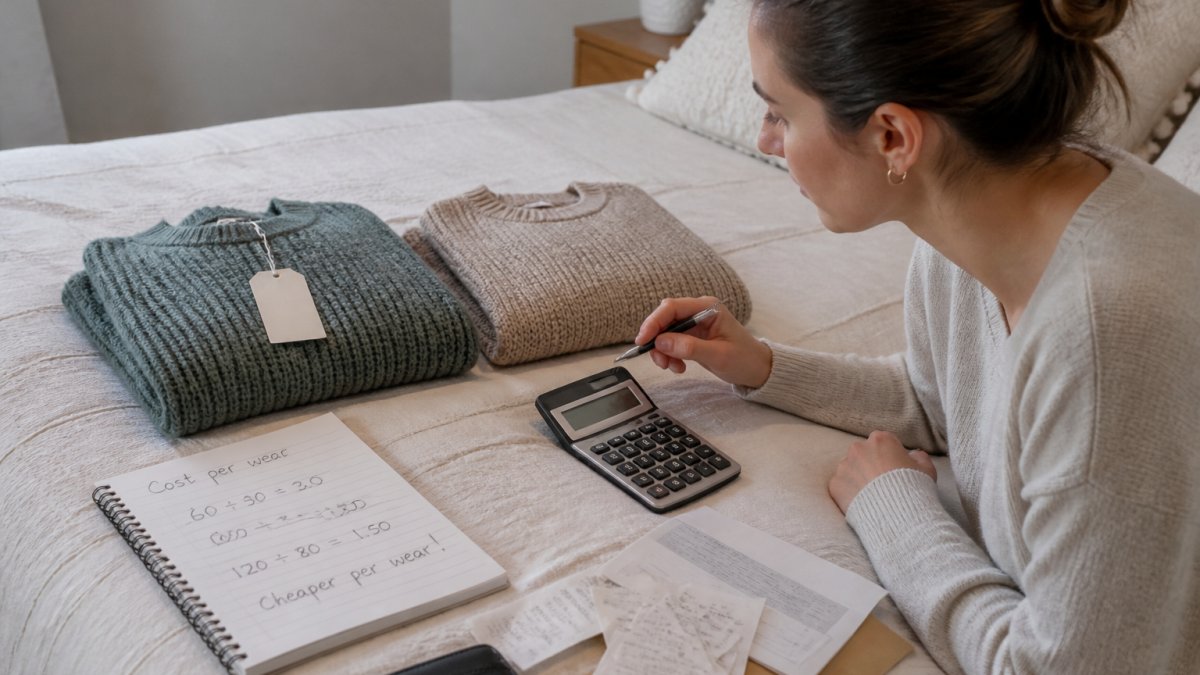
That is the whole framework, and why price premium arguments fall apart so fast: the upfront number is not the cost. The cost is the upfront number divided by wears.
Run the math on your own closet before you buy anything new:
| Garment | Purchase Price | Wears Per Year | Years Worn | Cost Per Wear |
|---|---|---|---|---|
| Fast fashion tee | $12 | 15 | 1 | $0.80 |
| Mid-range tee | $45 | 40 | 3 | $0.38 |
| Quality denim | $90 | 60 | 4 | $0.38 |
| Fast fashion denim | $30 | 20 | 1 | $1.50 |
The break-even point is the number of wears where a pricier garment becomes cheaper than the alternative.
Affordable sustainable clothing: how to build a wardrobe without the premium
Affordable sustainable clothing is possible if you change where you shop, not just what you buy. Secondhand apparel, resale platforms, and pre-loved clothing carry the same quality at a fraction of the original price, and for some categories, they are the better choice even if you can afford new.
The secondhand market has grown fast for a simple reason: a quality garment that already exists needs no new resources. Buying pre-loved clothing keeps it in circulation and skips production costs entirely.
2023 Men's Plus Size Fleece Zip Mock Neck Sweater →
Five lower-cost routes, ranked by effort
- Shop secondhand first. Thrift stores, consignment shops, and online resale platforms carry quality garments at deep discounts. For denim, outerwear, and sweaters, resale is often the best value in the market.
- Buy fewer, better pieces. Five well-made items beat fifteen cheap ones, and the cost per wear usually wins, but only if you actually wear them.
- Watch for end-of-season sales. Quality brands discount heavily when a season turns, and the garment is unchanged. Late-winter and late-summer clearance runs deepest.
- Repair before replacing. A tailor can fix a hem or replace a zipper for far less than a new garment. Build a relationship with one local tailor and repairs become routine.
- Try rental or swaps. For occasion wear you will wear once or twice, rental beats buying at any price. Local clothing swaps and online swap groups move quality pieces between wardrobes at zero cost.
A practical decision framework by clothing category
Not every category deserves the premium. Here is where paying more tends to pay off, and where it usually does not:
| Category | Pay More? | Why |
|---|---|---|
| Everyday basics (tees, tanks) | Sometimes | High wear frequency, but fabric is simple, mid-range often beats both extremes |
| Denim | Yes | Wear frequency is high, construction matters, and resale value holds |
| Outerwear and jackets | Yes | Long lifespan, repair-friendly, and the cost per wear drops fast |
| Sweaters and knitwear | Yes, if wool | Wool holds shape and resells; acrylic blends pill and fade |
| Occasion wear | No | Rent, borrow, or buy secondhand, wear count is too low to justify new |
| Trend-driven pieces | No | Buy secondhand or skip; the trend outlives the garment |
| Athletic wear | Depends | Recycled synthetics perform well, but fast-fashion versions are often adequate |
| Underwear and socks | No | Replacement cycle is short regardless of price |
The pattern is consistent: pay more where wear frequency is high and the garment is repairable. Save where the wear count is low or the item is disposable by nature.
Where to start if your budget is tight
If you cannot afford premium new clothing, do not force it. Start with categories where secondhand quality is highest, denim, wool coats, leather shoes, and buy basics new at mid-range prices.
We stock pieces like the 2023 Men's Plus Size Fleece Zip Mock Neck Sweater at $17.76 and the High Waist A-Line Corduroy Skirt for Women at $32.64. Both are built for repeat wear, which is what actually drives cost per wear down.

How to identify sustainable fashion brands (and catch greenwashing)
You can identify sustainable fashion brands by checking three things: material sourcing, factory certification, and whether the brand publishes specifics rather than slogans. Vague language is the clearest warning sign.
Greenwashing is when a brand markets itself as environmentally responsible without the practices to back it up. The FTC Green Guides exist specifically to police this, and they require claims to be specific, substantiated, and not misleading.
A quick verification checklist:
- Does the brand name its factories or suppliers?
- Are certifications listed with a certifying body, not just a logo?
- Is the material composition stated as a percentage, not a buzzword?
Materials and durability: which sustainable fabrics earn their price
Sustainable fabrics earn their price when they outlast the alternative. Linen, organic cotton, and quality wool hold up over years.
Material sourcing is where the cost difference starts. Here is how common sustainable materials compare on durability and care:
| Fabric | Durability | Care Level | Best For |
|---|---|---|---|
| Linen | High, softens with age | Medium, wrinkles | Warm-weather staples |
| Organic cotton | High with proper care | Easy | Everyday basics |
| Wool | High, holds shape | Medium, hand wash | Cold-weather layers |
| Recycled polyester | Medium | Easy | Activewear, outerwear |
| Conventional polyester | Low to medium | Easy | Fast fashion basics |
Durability is not only about the fiber. Stitching, fabric weight, and construction matter as much.
This is where the trade-off shows up: some sustainable materials need more careful care, a real cost in time. Linen wrinkles; wool needs gentler washing.
For everyday wear, we point shoppers toward pieces built to take repeat use, like the Spider Denim Pants at $69.54, made from durable denim with a washed finish, or the F1 Racing Jacket at $74.46 for a mid-weight layer that holds up across seasons.


Conclusion: when sustainable fashion is worth it for you
Sustainable fashion is worth the price when you will wear the garment often enough to bring cost per wear below the cheap alternative.
That is the honest answer, and more useful than a blanket yes or no: match the purchase to the wear count.
If you are building a wardrobe of pieces designed for repeat wear, Trending Now Co. curates clothing and lifestyle items with fast shipping and a rotating selection, so you are not stuck browsing the same rack every week.
Frequently Asked Questions
Is sustainable fashion worth the extra cost?
It depends on how many times you wear the piece. A $60 sustainable sweater worn 100 times costs $0.60 per wear. A $20 fast fashion sweater worn 10 times before it pills or tears costs $2.00 per wear. The sustainable option often wins on cost per wear clothing math even though the purchase price is higher. The catch is that you have to actually wear it repeatedly, which means buying pieces that fit your real life rather than a trend cycle.
Why is sustainable clothing more expensive?
The price premium covers things fast fashion skips: fair wages for garment workers, smaller production runs, certified organic or recycled fibers, and safer dye processes. A sustainable t-shirt might cost $35 to produce versus $5 for a mass-market equivalent because the brand isn't squeezing costs out of labor or the environment. You're paying for responsible production, not just the fabric. That gap narrows when you buy secondhand or shop sales from sustainable brands.
Does sustainable clothing last longer than fast fashion?
Generally yes, because the construction and materials are better. Higher-quality cotton, wool, and linen hold their shape and color longer than thin polyester blends. Reinforced seams, real buttons instead of glued ones, and proper finishing all extend garment longevity. That said, longevity also depends on care. Washing less often, air-drying, and storing properly can double the lifespan of any garment, sustainable or not.
How can I buy sustainable clothes on a budget?
Start with secondhand and resale. Pre-loved clothing from sites like ThredUp or local consignment shops gives you quality garments at fast fashion prices. Buy fewer pieces but choose versatile ones you'll wear weekly. Shop end-of-season sales from sustainable brands, which can drop prices 40-60%. Also look for brands that offer repair services or take-back programs, which stretch the value of what you already own.
How can you tell if a clothing brand is truly sustainable?
Look for third-party certifications, not marketing language. B Corp certification, GOTS for organic cotton, and Bluesign for chemical safety are verifiable. Check whether the brand publishes a supplier list or annual impact report. Vague terms like 'eco-friendly' or 'green' without specifics are a red flag. If a brand can't tell you where its fabric comes from or who made the garment, the sustainability claim is probably marketing.
The real challenge is not deciding whether sustainable fashion is worth it. It is finding quality pieces without overpaying or guessing. Trending Now Co. curates trending clothing across categories, ships fast, and refreshes its selection so you always find something new. Browse our clothing collection, pick one piece built for repeat wear, and let cost per wear make the case. Shop Now.