
Table of Contents
- Why Limited Counter Space Happens and What to Do First
- How to Declutter Kitchen Countertops Before You Buy Anything
- Vertical Storage Solutions for Kitchen Walls and Cabinet Doors
- Best Kitchen Organizers for Small Spaces That Actually Fit
- Creating Temporary Prep Space When You Have None
- Ergonomic Workflow and Maintenance Habits for Tiny Kitchens
- Frequently Asked Questions
Last Updated: September 30, 2026
Why Limited Counter Space Happens and What to Do First
Learning small kitchen organization with limited counter space starts with one honest truth: most kitchens don't lack storage, they lack a plan. The average small kitchen packs appliances, dishes, and food into a space built for half of it. That's why the fix isn't buying more stuff. It's deciding what stays, what moves, and where it lives.
The Real Cost of Cluttered Counters
A buried counter costs you time every single day. You chop on a sliver of free space, hunt for the spatula, and wipe around three appliances you used once.
How to Declutter Kitchen Countertops Before You Buy Anything
Decluttering comes first, because organizers can't fix a space that holds too much. Skip this step and you'll just be storing clutter more neatly.
The Keep, Relocate, Donate Method
Sort every counter item into one of three piles:
- Keep: Used at least weekly and needs to stay within arm's reach
- Relocate: Used often, but belongs in a cabinet, drawer, or pantry
- Donate: Unused for a year, duplicates, or broken beyond repair
Work in 15-minute rounds so you don't burn out. Finish one counter section before starting the next.
Vertical Storage Solutions for Kitchen Walls and Cabinet Doors
Vertical storage solutions for kitchen walls turn dead space into working space. The average kitchen has metres of bare wall and unused cabinet door backs. Both can hold what's crowding your counter.
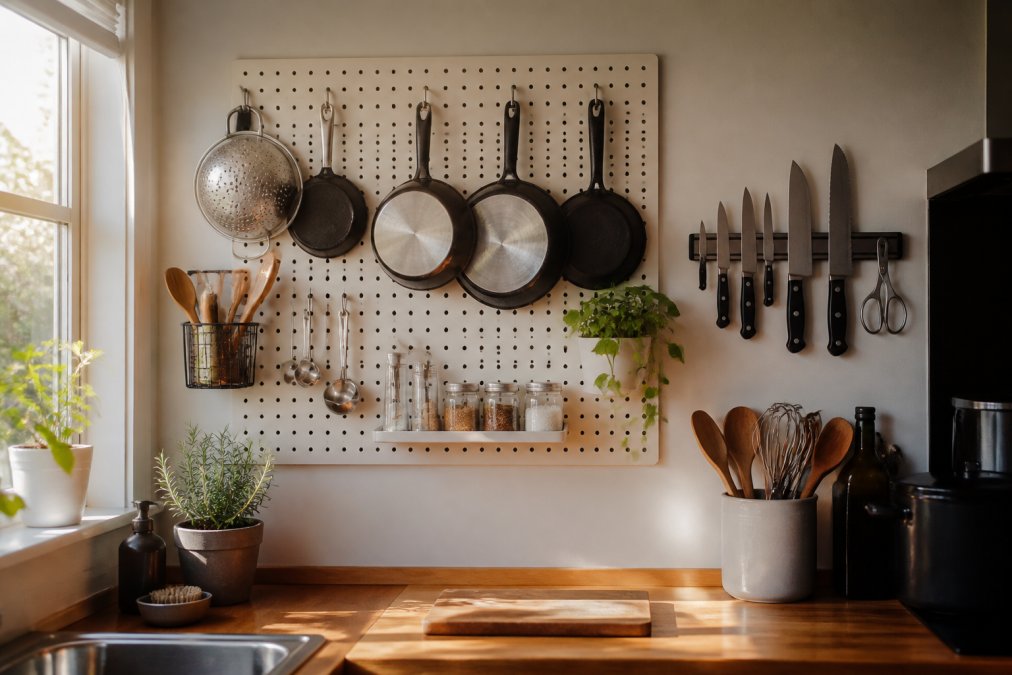
Start with the wall above your prep zone:
- A pegboard holds utensils, small pans, and measuring cups
- Magnetic knife strips free up a drawer and keep blades handy
- Wall-mounted racks handle spices, foil, and wrap
- Over-the-door organizers fit inside cabinet doors for lids and cutting boards
Rental-Friendly No-Drill Options
Renters can't drill, but they can still use vertical space. Try these instead:
- Command-style adhesive hooks for light tools and towels
- Tension rods inside cabinets for spray bottles and wraps
- Over-the-door racks that hang without hardware
- Freestanding shelving that moves with you
Best Kitchen Organizers for Small Spaces That Actually Fit
The best kitchen organizers for small spaces share one trait: they match your cabinet depth. Measure before you buy, or you'll end up with risers that don't clear the shelf above.
Drawer and Cabinet Inserts Worth Buying
These are the pieces that earn their space:
- Drawer dividers keep utensils and gadgets from sliding into a pile
- Shelf risers double your vertical stacking in cabinets
- Lazy susans make deep corner cabinets usable
- Stackable containers group dry goods by type
- Cabinet door storage adds a slim shelf where there was none
| Problem | Organizer | Where It Goes | Impact |
|---|---|---|---|
| Piled utensils | Drawer dividers | Top drawer | Fast grab, no digging |
| Wasted shelf height | Shelf risers | Upper cabinets | Doubles stacking room |
| Lost corner items | Lazy susan | Corner base cabinet | Full corner access |
| Scattered dry goods | Stackable containers | Pantry shelf | Visible, grouped food |
| Empty door backs | Door storage rack | Cabinet doors | Extra slim storage |
For food storage, the Vacuum Sealed Food Storage Box & Sealer is a strong pick. It's stackable, comes in multiple sizes, and includes a free vacuum pump, so it saves cabinet space while keeping meals fresh.

Creating Temporary Prep Space When You Have None
Temporary prep space is any stable surface you can create in seconds and clear just as fast. The goal is a cutting zone that holds a full-size board without wobbling, not a permanent remodel. Most small kitchens can reclaim 2 to 4 square feet this way, which is often the difference between cooking and ordering out.
- A sink bridge or over-sink cutting board spans the basin and typically adds 18 to 24 inches of length. Look for rubberized feet or adjustable arms so it doesn't slide. The trade-off: you can't use the sink while it's in place, so it works best for quick prep, not a full meal.
- A stovetop cover or burner grate cover turns cold burners into counter. Choose one rated for your burner type, a cover that fits a gas grate usually won't sit flat on a glass electric top. The trade-off: you must remove it before you cook, so it only helps during prep.
- A pull-out cutting board installs in a cabinet slot above a drawer and slides away when you're done. It preserves the counter entirely but requires cabinet modification, which rules it out for renters.
- A rolling cart or butcher-block island adds a movable surface you can park against a wall and pull out when you cook. A 24-by-18-inch cart fits most galley kitchens and stores your chopper, board, and bowls underneath. The trade-off is floor space, measure your walkway before you commit.
Rental-Friendly, No-Drill Ways to Add Prep Space
If you can't cut into cabinets or drill into counters, you still have options. A common pattern among renters is to stack two or three of these so the prep zone moves with you:
- Over-the-sink boards with adjustable arms need no hardware at all.
- Freestanding butcher-block carts on locking casters give you a real cutting surface and roll away for storage.
- Countertop extension arms clamp onto an existing counter edge and fold down when not in use, check the clamp width against your counter's thickness first.
- A sturdy over-the-fridge or over-the-toilet-style rack repurposed as a slim prep shelf works in narrow galley layouts, though it holds light items only.
Pairing Prep Space With Multi-Tasking Tools
Once you have a surface, the next constraint is how many tools it has to hold. Every tool that does two jobs frees counter inches. A chopper that dices and slices in one pass means less board time and fewer gadgets out. A drain basket that also serves as a salad bowl replaces two items with one. A measuring spoon scale replaces an entire set of measuring cups because it weighs flour, sugar, and cocoa directly.
Ergonomic Workflow and Maintenance Habits for Tiny Kitchens
Most small-kitchen guides stop at storage. The bigger win in a tight kitchen is workflow, arranging what you own around the order you actually cook in, not around categories. In a kitchen under roughly 50 square feet, a poorly sequenced layout can add several steps to every meal, and those steps are what push people toward takeout.
Build Zones Around the Cooking Sequence
Instead of grouping by type (all spices together, all tools together), group by the moment you reach for them. Three zones cover almost every meal:
- Prep zone: cutting board, knife, chopper, mixing bowl, scraps container. This should sit between the refrigerator and the sink so you can pull ingredients, rinse, and chop without crossing the room.
- Cook zone: stove, oil, salt, spices, spoon rest, oven mitts. Keep everything within one arm's reach of the burners so you're not turning your back on a hot pan.
- Clean zone: sink, drain basket, drying rack, sponge, trash. Place this adjacent to prep so scraps and dirty tools move one step, not five.
The One-Reach Rule
A simple test: stand where you cook and reach with one arm. Anything you use daily should be inside that arc. Anything you use weekly can live one step away. Anything seasonal or occasional goes high, deep, or out entirely. This single rule resolves most "where does this go" questions faster than any labeling system.

Habits That Keep Counters Clear
Organizing is a process, not a one-time event. Two habits do most of the work:
- Daily reset (5 minutes): after dinner, clear the counters, return tools to their zones, and wipe the prep surface. The point isn't perfection, it's that tomorrow's cooking starts from a clear surface instead of a pile.
- Weekly sweep (10 minutes): before you shop, pull anything that's migrated onto the counter and put it back. Counters collect mail, chargers, and keys as much as kitchen gear, and a weekly sweep catches the drift before it becomes the default.
- Monthly audit (15 minutes): pull one item you haven't used in a month and relocate or donate it. Over a year, that's twelve fewer things competing for the same square footage.
Food Storage Fits the Same Logic
A tidy shelf and safe food storage are the same problem. Grouping food by type, and by how soon you'll use it, makes rotation automatic and reduces spoilage. According to the FDA's guidance on refrigerator and food safety, proper storage temperature and rotation matter as much as a clean shelf. In a small kitchen, front-load the items you'll use this week and push the rest back, so nothing gets lost behind the front row.
Frequently Asked Questions
How do you organize a kitchen with no counter space?
Start by clearing everything off the counters and only returning items you use daily. Mount vertical storage like pegboards, magnetic knife strips, or wall racks to move tools off the surface. Use in-sink drying racks and over-the-door organizers to free up cabinet space. A chopping board bridge over the sink creates instant prep area. The goal is to treat your counter as a workspace, not a storage shelf.
What are the best kitchen organizers for small spaces?
Drawer dividers, shelf risers, stackable containers, and lazy Susans work well because they use vertical height inside cabinets. Over-the-door organizers add storage without drilling. Magnetic knife strips and wall-mounted racks clear counter space. For food storage, stackable vacuum-sealed boxes keep pantry items compact and visible. Measure your cabinet depth before buying anything, since inserts that don't fit waste both money and space.
How can I create more prep space in a tiny kitchen?
Pull-out cutting boards that slide over a drawer or sink give you instant prep area without permanent installation. A chopping board bridge that spans the sink adds a stable surface for chopping. Stove covers turn your cooktop into temporary counter space when you're not cooking. Storing small-footprint appliances in cabinets and only bringing them out when needed keeps your prep zone clear for actual work.
How do you declutter a small kitchen effectively?
Pull everything out of your cabinets and counters, then sort into three piles: keep, relocate, and donate. Anything you haven't used in a year goes. Duplicates like three spatulas or four mixing bowls get reduced to one or two. Store rarely used items in high or hard-to-reach cabinets. Once you've purged, you'll find you need fewer organizers, which saves money and keeps the kitchen functional.
A cramped kitchen stays frustrating until you change the system, not just the shelf. Trending Now Co. curates the small-space tools that do the heavy lifting, from stackable food storage to multi-use prep gear, all in one place with fast shipping. Browse the collection, pick the pieces that match your counter, and get started with Trending Now Co. today.